

The modern workplace has undergone a great shift; whether your team sits in a glass-walled office or is scattered across a dozen different time zones, the fundamental challenge remains the same: how do you ensure the work is getting done without becoming a hovering presence that stifles creativity?
Now, for many leaders, the instinct to frequently ask for updates is born from a desire for excellence. Yet, there is an inconsistency in the overall management. The more you ask for updates, the less time your team has to actually produce the work you are asking about.
Learning how to track team productivity is not about installing a digital tool. It is about building a transparent ecosystem where data speaks louder than constant pings. When you implement the right project progress tracking tools, you not only gain visibility but also boost team productivity, transitioning from a manager who polices time to a leader who facilitates outcomes.
Take control of your projects without micromanaging, start tracking progress today.
The Psychology of the Check-In, and Why We Micromanage
To understand how to avoid micromanagement, we must first look at why it happens. Most managers do not set out to be overbearing. Micromanagement is often a symptom of systemic anxiety. When there is no clear visibility into a project, a manager feels blind. To compensate for this lack of vision, they reach out quite repeatedly.
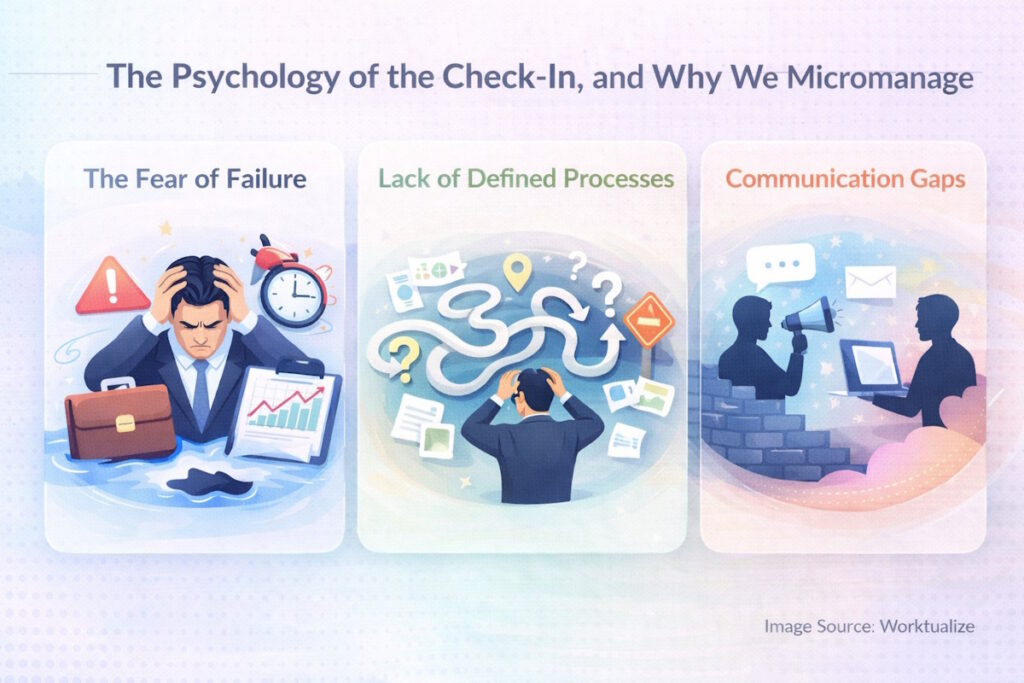
- The Fear of Failure: If a project fails, the manager is often the one held accountable. This pressure leads to a desire for minute-by-minute control.
- Lack of Defined Processes: Without a clear roadmap, every step feels like a potential detour.
- Communication Gaps: When information does not flow naturally, it must be forced out through meetings and emails.
However, the cost of this behavior is high. It creates a culture of dependency. If you manage every detail, your team stops thinking for themselves. They wait for your direction, which effectively doubles your workload and halves their efficiency.
How to Track Project Progress Silently and Redefine Visibility
The secret to high-level oversight is silent visibility. You should be able to see exactly where a project stands at 2:00 PM on a Tuesday without sending a single Slack message or making a phone call. This is achieved through a combination of cultural shifts and technical implementations.
Setting the Foundation with OKRs and KPIs
Before you can effectively track project progress, you need to define what progress looks like. Objectives and Key Results (OKRs) provide a high-level view of what the team is trying to achieve. Key Performance Indicators (KPIs) provide the granular data points. When these are clearly defined and stored in a shared space, the manager can monitor employee productivity by simply checking the dashboard against the targets.
The Power of Visual Workflows
Human brains process visual information significantly faster than text. Using Kanban boards or Gantt charts within your project progress tracking tools, along with agile time tracking tools, allows you to see the flow of work. You can identify if a task is stuck in the Review column for three days without having to ask the reviewer why. This visual transparency is the ultimate antidote to the urge to micromanage.
Strategies to Monitor Employee Productivity Without Intrusion
Many managers worry that if they stop checking in, productivity will dip. In reality, the opposite is usually true. When employees feel trusted, they often work more effectively. Here is how to maintain a high-performance environment while stepping back.
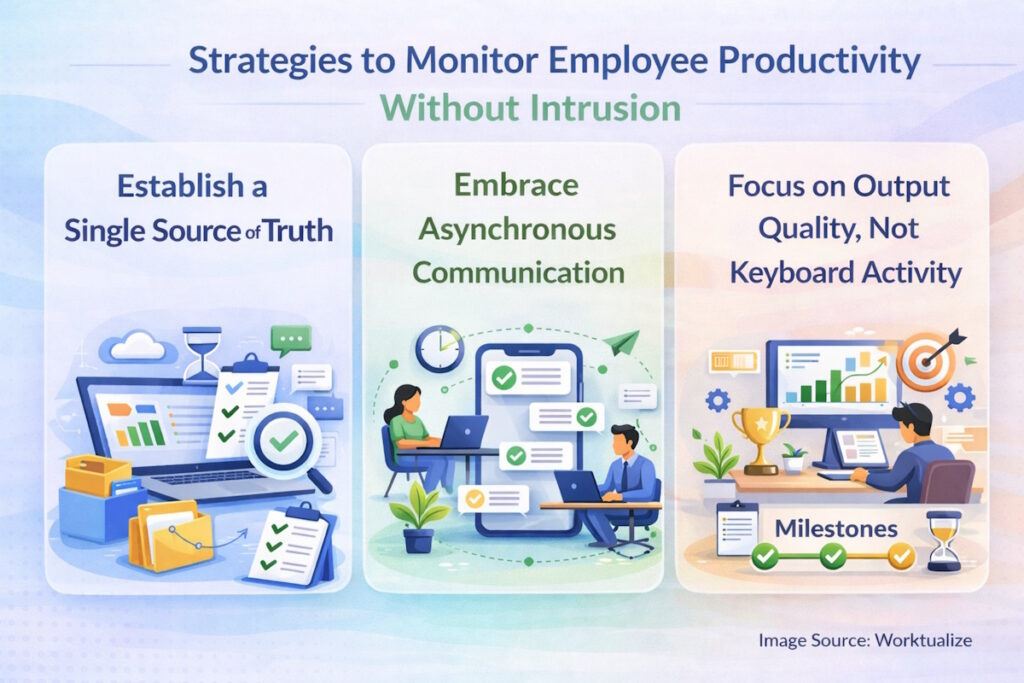
1. Establish a Single Source of Truth
The primary reason managers nag is that information is scattered. One update is in an email, another is in a chat thread, and a third is in a spreadsheet. To track project progress efficiently, you must mandate that all updates live in one place. If it is not in the project tool, it did not happen. This discipline saves everyone time.
2. Embrace Asynchronous Communication
Meetings are the enemy of deep work. Instead of a daily stand-up that interrupts everyone’s morning, move to asynchronous updates. A simple prompt in your communication tool—What did you do yesterday? What are you doing today? Any blockers?—allows team members to respond when they reach a natural breaking point in their work. This is a core strategy in how to avoid micromanagement.
3. Focus on Output Quality, Not Keyboard Activity
When you approach employee productivity tracking, do not get caught up in how many hours someone was active on their computer. A developer might spend four hours staring at a screen, thinking, and then write the perfect code in thirty minutes. If you only track the thirty minutes of typing, you miss the four hours of high-value cognitive work. Focus on whether the milestones are being met on time and at the required quality.
Overcoming the Remote Work Visibility Gap
The rise of remote work has made the question of how to track team productivity even more pressing. Without the physical presence of an office, some managers feel they have lost control. This often leads to an explosion of Zoom meetings, which are even more draining than in-person ones.
To bridge this gap, you need a system that mimics the natural observation of an office without the intrusion. Digital project progress tracking tools provide a virtual floor plan. You can see who is working on what, the current status of various sub-tasks, and the projected completion dates based on current velocity. This data-driven approach allows you to monitor employee productivity across different time zones without waking anyone up for a status report.
Want real-time visibility without constant follow-ups? Find how smart tracking tools can help.
How to Avoid Micromanagement: Practical Steps for Managers
If you find yourself struggling to let go, try these incremental steps:
- The 24-Hour Rule: Before you send a follow-up message on a non-urgent task, wait 24 hours. Often, the update will come through naturally before your timer is up.
- Delegate the Outcome, Not the Process: Tell your team what the final result should look like, but let them decide the steps to get there. You can track project progress by checking in on the results of those steps rather than dictating the steps themselves.
- Ask for Blockers, Not Status: Instead of asking, Is it done yet?, ask, Is there anything stopping you from finishing this? This positions you as a supporter rather than a taskmaster.
Data-Driven Decision Making
When you monitor employee productivity through data rather than intuition, your decisions become much more objective. For example, if the data shows a certain team member’s output has dropped, you can have a supportive conversation about their workload or potential burnout. This is much more effective than assuming they are slacking off because they didn’t reply to a message instantly.
Using project progress tracking tools allows you to see the big picture. You can spot trends over months, not just days. This long-form data is invaluable for resource planning and setting realistic deadlines for future projects. It takes the guesswork out of management.
Worktualize is the Ultimate Solution for Modern Teams
Achieving this balance of oversight and freedom is the core mission of Worktualize. We recognized that traditional management styles were failing in the digital age. Managers were stressed, and employees were feeling suffocated. Worktualize was designed to be the bridge that brings these two groups together through transparency and efficiency.
Why Worktualize is the Essential Choice
Worktualize is more than just a timer; it is a comprehensive suite designed to track project progress while fostering a culture of trust. It serves as a powerful ally for both in-house and remote teams.
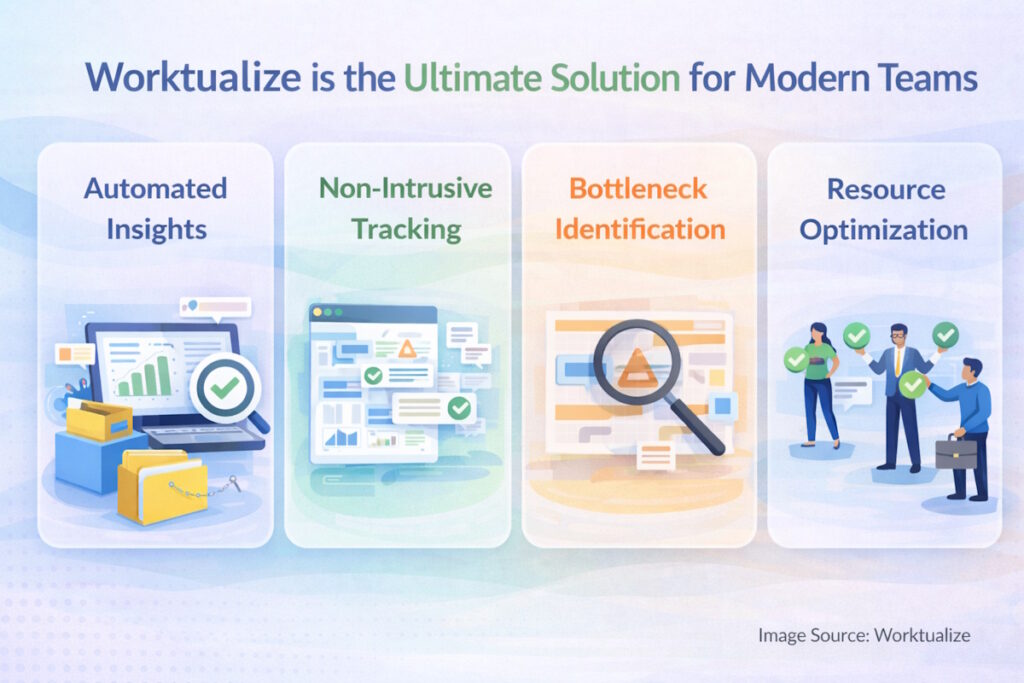
- Automated Insights: Instead of manual reports, Worktualize provides automated summaries of how time is being spent. This allows you to monitor employee productivity at a glance without ever having to interrupt a workflow.
- Non-Intrusive Tracking: Our philosophy is built on how to avoid micromanagement. Our tracking is designed to be a background helper, not a digital spy. It gives employees the tools to manage their own time while providing managers with the high-level data they need.
- Bottleneck Identification: One of the best ways to track project progress is to see where things slow down. Worktualize shows all necessary areas where tasks are lingering, allowing you to step in and provide support exactly where it is needed.
- Resource Optimization: Understanding how to track team productivity accurately, you can ensure that work is distributed fairly. No one is overloaded, and no one is underutilized, leading to better morale and higher-quality outcomes.
Enhancing Outcomes with Worktualize
Organizations that use Worktualize see a marked improvement in their project delivery times. When teams remove the friction of constant check-ins, they stay in the flow state longer. When managers use our project progress tracking tools, they spend 40% less time on administrative oversight and 40% more time on strategic growth.
Worktualize empowers your employees to take ownership of their productivity. When they can see their own data, they become self-correcting. This is the ultimate goal of any leader: to create a team that manages itself, supported by a manager who provides the vision and the tools.
Building the Future of Work with Worktualize
The transition away from micromanagement is not just a trend; it is a necessity for any organization that wants to attract and retain top talent. High-performers do not stay in environments where they are not trusted. Learning how to track team productivity through modern, data-driven methods, you are future-proofing your leadership style.
When you choose to track project progress through a tool like Worktualize, you are sending a clear message to your team: I value your results more than I value watching you work. This trust is the foundation of innovation. It is the reason why some companies scale effortlessly while others struggle with internal friction.
Final Thoughts on Effective Management
Management is a craft. Like any craft, it requires the right tools. You wouldn’t try to build a house without a blueprint, so why try to manage a complex project without a clear data stream? Stop the cycle of constant check-ins. Stop the anxiety of the unknown.
Implementing structured project progress tracking tools, focusing on outcomes, and utilizing a platform like Worktualize, you can monitor employee productivity with confidence. You will find that when you stop looking over their shoulders, your team will actually move faster, reach further, and achieve more than you ever thought possible.
The era of the micromanager is over. The era of the empowered, data-informed leader has begun.
Ready to lead without micromanaging? Turn productivity into a data-driven advantage with the right tools.