

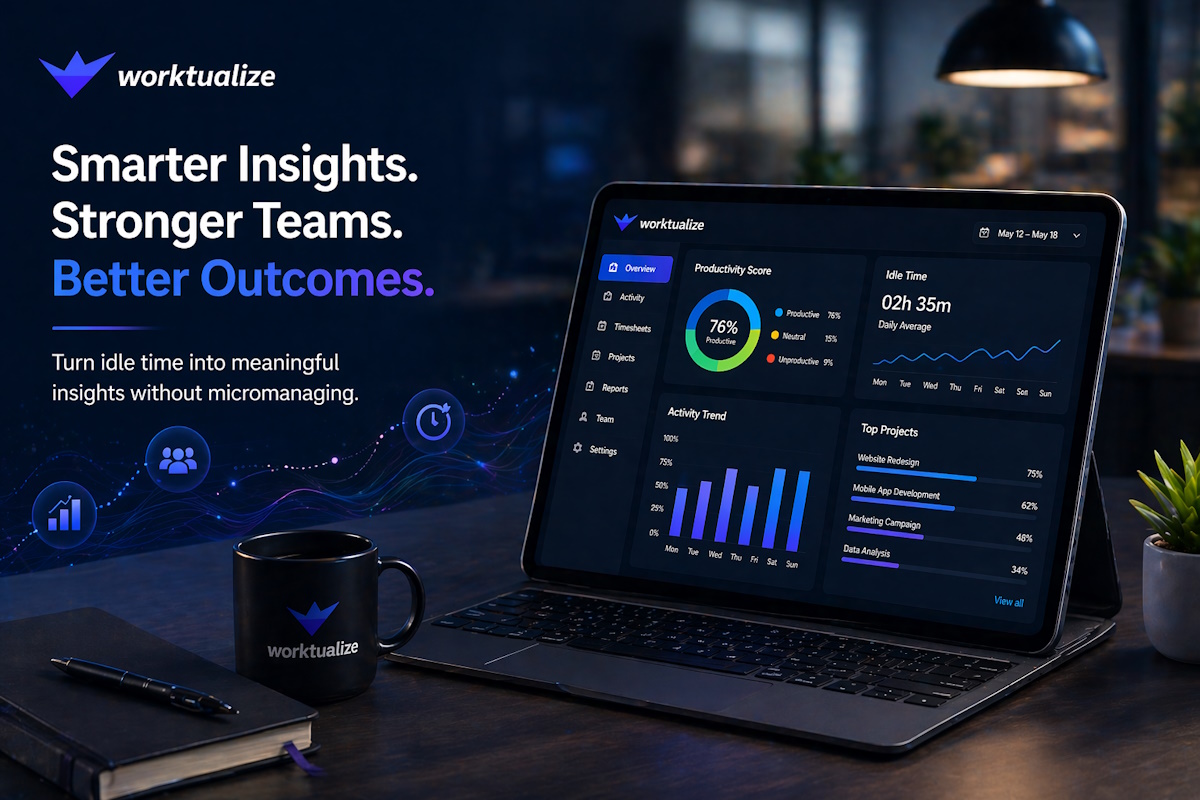
Modern workplaces are overflowing with data, yet many leaders still struggle to interpret it correctly. Tools that measure employee activity levels, advanced workforce monitoring techniques, and sophisticated idle time tracking software promise clarity. However, without the right mindset, these tools can easily lead to micromanagement instead of meaningful insights.
At the core of this challenge lies a misunderstanding: not all idle time is wasted, and not all activity signals productivity. Creative work, strategic thinking, and problem-solving often happen in moments that traditional systems classify as idle. The real task for businesses is not to eliminate idle time, but to interpret it intelligently while maintaining trust and autonomy.
This blog explores how organizations can strike that balance, using idle time tracking software, workforce monitoring techniques, and employee activity levels as tools for empowerment rather than control.
Want better productivity insights and smarter team management?
Managing Idle Time in the Modern Workplace
Idle time is commonly defined as periods without keyboard or mouse activity. Most idle time tracking software automatically logs these gaps, categorizing them as unproductive. But that definition is far too simplistic for knowledge-driven roles.
In reality, idle time often includes critical work that simply does not register as physical activity. When organizations rely solely on surface-level data, they risk misjudging performance and undervaluing deep work.
To better understand idle time, consider how it shows up in everyday work:
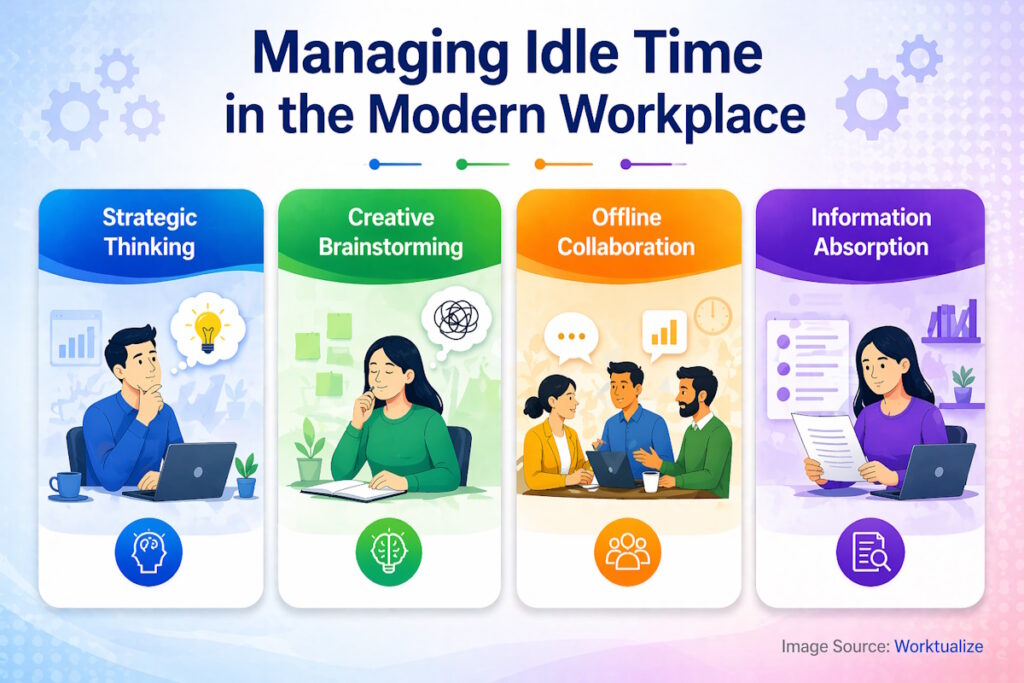
- Strategic thinking often requires stepping away from the screen to connect ideas, analyze problems, and plan solutions effectively.
- Creative brainstorming involves mental exploration where ideas form gradually without continuous typing or clicking.
- Offline collaboration such as meetings or discussions may not reflect high employee activity levels but contributes directly to outcomes.
- Reviewing documents or absorbing information can appear idle, yet it is essential for informed decision-making and accuracy.
Modern workforce monitoring techniques must evolve to recognize these nuances. Idle time tracking software should not just detect inactivity, but provide context that helps distinguish productive thinking from disengagement.
The Misleading Nature of Employee Activity Levels
Employee activity levels are one of the most commonly used productivity metrics. They are easy to measure and visualize, making them attractive for managers seeking quick insights. However, these metrics can be misleading when taken at face value.
High activity does not necessarily equal high productivity, and low activity does not automatically indicate poor performance. In fact, overemphasis on employee activity levels can create unintended consequences.
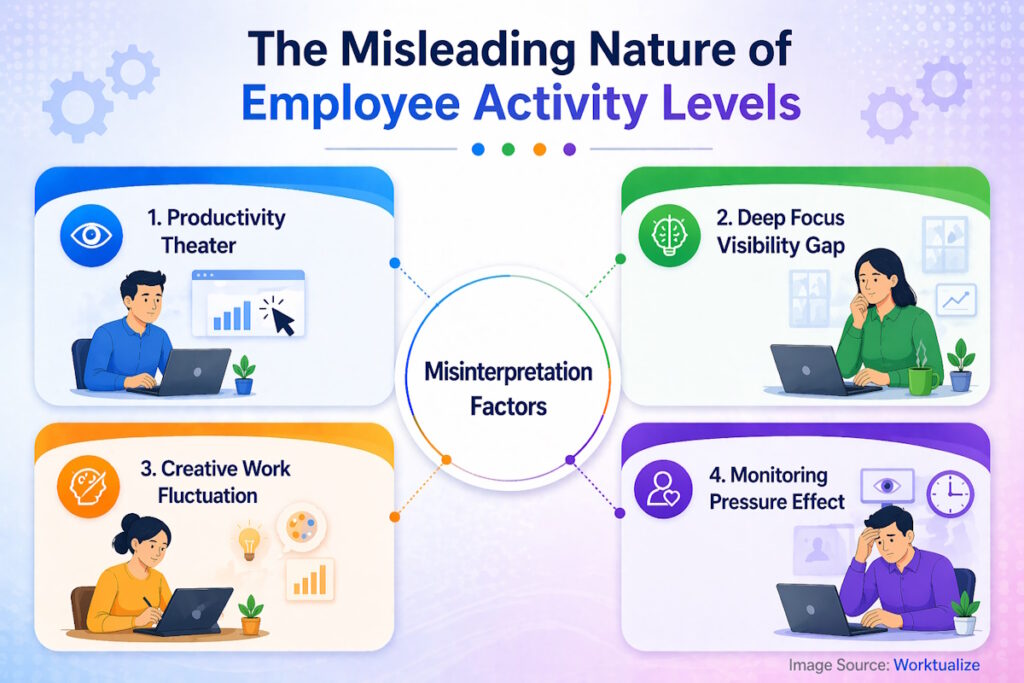
Here is how misinterpretation happens:
- Employees may prioritize appearing active over doing meaningful work, leading to unnecessary clicks or constant screen engagement.
- Deep focus tasks often reduce visible activity, causing valuable work to be flagged incorrectly by idle time tracking software.
- Creative roles naturally fluctuate in activity levels, making rigid benchmarks ineffective and demotivating.
- Continuous monitoring can pressure employees to avoid breaks, reducing long-term efficiency and increasing burnout risk.
Effective workforce monitoring techniques should treat employee activity levels as one piece of a larger puzzle, not the ultimate measure of productivity.
Understanding the Role of Creative Flow
Creative flow is the state where individuals are fully immersed in their work. It is often where the highest-value output happens, yet it does not always align with high employee activity levels.
During creative flow, employees may pause, reflect, or step away from their devices. Traditional idle time tracking software might interpret these moments as inactivity, but they are actually critical to producing quality work.
Creative flow typically includes:
- Periods of deep concentration where minimal physical interaction occurs but cognitive effort is at its peak.
- Moments of pause that allow ideas to mature, often resulting in more innovative and thoughtful outcomes.
- Iterative thinking where employees mentally refine solutions before executing them digitally.
- Reduced multitasking, leading to fewer visible interactions but significantly higher quality results.
Recognizing creative flow is essential for refining workforce monitoring techniques and ensuring that employee activity levels are interpreted with context.
The Fine Line Between Monitoring and Micromanaging
Many organizations adopt idle time tracking software and employee monitoring tools with the intention of improving productivity, only to fall into the trap of micromanagement.
Micromanagement occurs when leaders focus too heavily on minute details rather than overall performance and outcomes. This often stems from over-reliance on employee activity levels without understanding their limitations.
Common signs of micromanagement through data include:
- Scrutinizing every minute of idle time without considering the nature of the work being performed.
- Setting unrealistic expectations for constant activity, ignoring natural work rhythms and cognitive needs.
- Using workforce monitoring techniques as surveillance tools rather than performance enablers.
- Penalizing employees for normal behavior such as thinking, resting, or transitioning between tasks.
To avoid these pitfalls, organizations must shift their perspective from control to insight.
Interpreting Workforce Data the Right Way
The key to effective workforce management lies in interpretation, not just collection. Idle time tracking software and employee activity levels provide valuable data, but their real power comes from how they are used. A balanced approach to workforce monitoring techniques involves looking beyond raw numbers and focusing on patterns, context, and outcomes.
Here are practical ways to interpret workforce data effectively:
- Focus on trends over time instead of isolated moments, identifying consistent patterns in employee activity levels and productivity.
- Combine quantitative metrics with qualitative insights such as feedback, project outcomes, and team collaboration quality.
- Categorize idle time into meaningful segments like breaks, meetings, deep thinking, and genuine inactivity for better clarity.
- Establish realistic benchmarks that reflect the nature of different roles rather than enforcing uniform activity standards.
- Use insights to improve workflows and remove obstacles instead of monitoring individuals excessively.
This approach transforms idle time tracking software into a strategic tool rather than a surveillance mechanism.
Need smarter monitoring without creating workplace pressure?
Turning Idle Time Into Actionable Insights
Idle time, when interpreted correctly, can reveal hidden opportunities for improvement. Instead of treating it as a problem, organizations can use it as a diagnostic signal.
Analyzing idle time alongside employee activity levels, businesses can uncover inefficiencies and optimize processes. Advanced workforce monitoring techniques make it possible to extract these insights without invading employee privacy or autonomy.
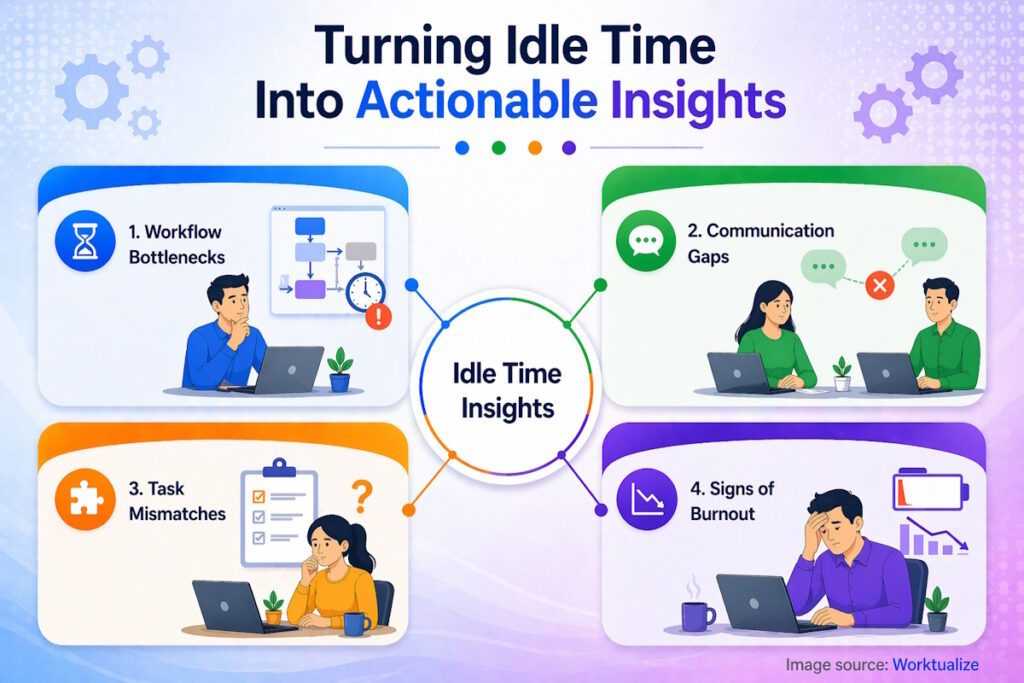
Idle time insights can help identify:
- Workflow bottlenecks where employees are waiting for inputs, approvals, or resources to proceed with tasks.
- Communication gaps that lead to delays and reduced employee activity levels across teams.
- Task mismatches where employees struggle due to unclear instructions or misaligned responsibilities.
- Signs of burnout when sudden drops in activity or increased idle time indicate disengagement or fatigue.
Building a Trust-Driven Monitoring Culture
The success of any monitoring strategy depends on how it is perceived by employees. Even the best idle time tracking software can fail if it creates fear or distrust.
When employees feel trusted, they are more likely to engage positively with monitoring systems and maintain healthy productivity levels. Organizations must prioritize transparency and collaboration when implementing workforce monitoring techniques.
A trust-driven approach includes:
- Clearly communicating the purpose of tracking employee activity levels and how the data will be used.
- Allowing employees to access and understand their own productivity data for self-improvement.
- Encouraging open discussions about idle time to provide context and eliminate misunderstandings.
- Respecting privacy by limiting intrusive tracking and focusing on aggregated insights instead of individual scrutiny.
How Worktualize Helps You Get It Right
Achieving the balance between insight and autonomy requires the right tools. This is where Worktualize stands out as a modern solution designed for today’s dynamic work environments.
Worktualize goes beyond basic idle time tracking software by offering a comprehensive platform that aligns with advanced workforce monitoring techniques while respecting employee independence. Unlike traditional tools, Worktualize focuses on enabling smarter decisions rather than enforcing rigid control, making it ideal for businesses that value both productivity and trust.
With Worktualize, organizations can:
- Track employee activity levels in real time while maintaining a clear understanding of work patterns and productivity trends.
- Analyze idle time with context, distinguishing between productive thinking and actual disengagement.
- Access detailed reports that combine activity data with project insights for better decision-making.
- Customize monitoring settings to suit different roles, ensuring fairness and relevance across teams.
Don’t Manage the Workforce, Worktualize it!
Idle time and creative flow are not opposing forces. They are both essential components of meaningful work. The challenge lies in understanding how they interact and using that knowledge to improve performance without compromising employee well-being.
Using idle time tracking software intelligently, refining workforce monitoring techniques, and interpreting employee activity levels with context, organizations can move beyond micromanagement and toward sustainable productivity.
The future of work is not about tracking every second. It is about understanding how work happens and creating environments where employees can perform at their best.
With the right approach and tools like Worktualize, businesses can turn workforce data into a powerful ally rather than a source of friction.