

In the fast-paced corporate landscape of 2026, the differentiation between busy and productive has never been wider. While most teams feel like they are sprinting, the data suggests a different reality. According to recent industry benchmarks published in the Sustainability Journal MDPI, organizations that leverage dedicated project management time tracking see a staggering 30% increase in project delivery speed compared to those relying on manual logs or gut feelings.
Despite this, nearly 82% of employees still lack a structured time management system. If your team is struggling with missed deadlines, over-stretched budgets, or the feeling that hours are simply vanishing into the workshop of endless emails and meetings, you aren’t just losing time; you’re losing your competitive edge. The question isn’t whether your team is working hard.
The question is: Do you know exactly what they are working on?
Want to know where your team’s time is really going?
Why We Feel Busy but Deliver Late in Productivity
On average, employees are productive for only about 2 hours and 53 minutes each day. The rest of the time is swallowed by an average of 60 interruptions daily, social media rabbit holes, and low-value tasks. In fact, research published on Inc. Magazine shows that most of the workday is spent on activities that offer zero value to core project responsibilities. This creates a psychological trap. We leave the office feeling exhausted, yet the project board hasn’t moved an inch.
Without employee time tracking tools, these inefficiencies remain invisible. Managers can’t fix what they can’t see. This lack of visibility leads to deadline drift: the slow, quiet delay of milestones that eventually results in project failure. When a manager cannot pinpoint exactly where a bottleneck occurs, they often resort to hiring more people, which only adds more complexity and communication overhead without solving the root cause of the delay.
How Time Tracking Software Benefits High-Performance Teams
Implementing time tracking software benefits the entire organizational hierarchy, from the C-suite to the entry-level associate. It transforms time from an abstract concept into a measurable asset. When you quantify the workday, you move away from subjective performance reviews and toward a meritocracy based on actual output and focus.
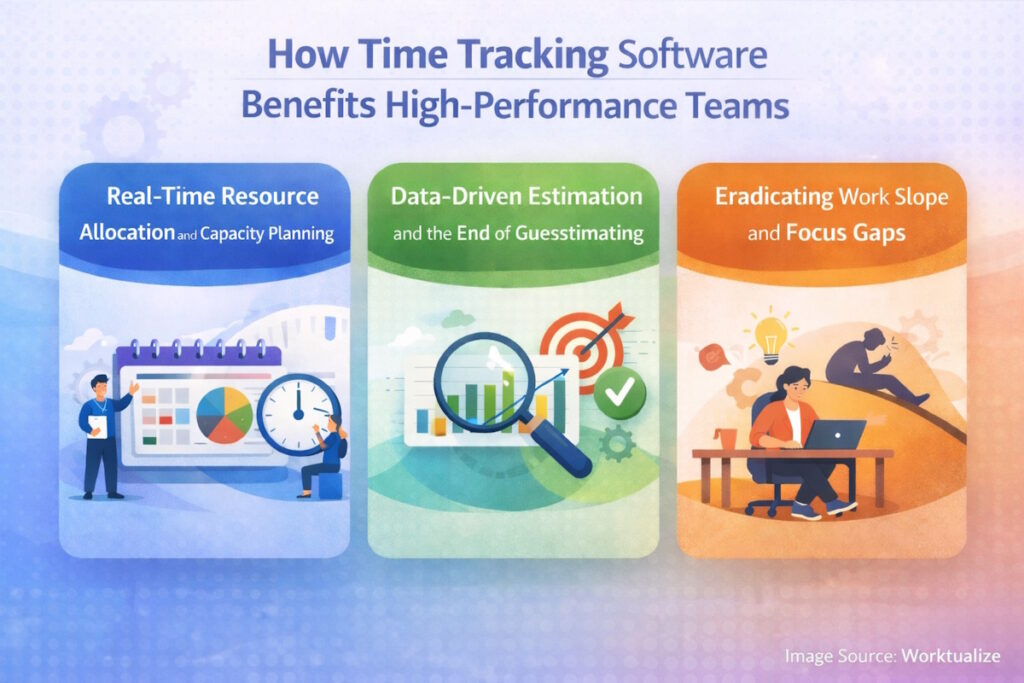
1. Real-Time Resource Allocation and Capacity Planning
One of the primary reasons projects stall is improper resource distribution. You might have one developer drowning in tasks while another has 20% bench time that goes unnoticed. Improving team productivity software allows managers to view heat maps of team utilization.
Identifying who is over-capacity and who has bandwidth, you can rebalance workloads in real-time. This prevents the burnout that often leads to high turnover rates and ensures the critical path of your project never stops moving due to a single person being overwhelmed.
2. Data-Driven Estimation and the End of Guesstimating
Why do projects go over budget? Usually, because the initial estimate was a guess. Historical data is the best predictor of future performance. Using project management time tracking, you can analyze how long similar tasks took in the past. This moves your planning phase from estimation to calculation.
When you can tell a client or a stakeholder that a specific module takes exactly 42 hours on average, your credibility skyrockets. It allows for realistic deadlines that your team can actually hit, which boosts morale and reduces the need for stressful crunch periods.
3. Eradicating Work Slope and Focus Gaps
When employees know their time is being tracked, accountability naturally rises. Employee time tracking tools help highlight focus gaps: those periods where a 15-minute task somehow takes two hours. Often, these gaps aren’t caused by laziness but by poor process.
Perhaps the employee is waiting for a file, or they are stuck in a feedback loop. Identifying these patterns, teams can implement deep work blocks and minimize the 25-minute recovery time usually required after a single interruption.
Ready to apply these time tracking software benefits in real time?
The 30% Speed Boost and Breaking Down the Mechanics
How does a simple tool lead to a 30% faster delivery?
It is not about making people work faster or forcing them to skip breaks. It is about making the workflow smoother and removing the friction that slows teams down.
| Feature | Impact on Delivery Speed |
| Automated Timesheets | Eliminates manual entry errors and saves 2 to 4 hours of admin time per week. |
| Idle Time Detection | Identifies bottlenecks in the workflow where tasks are stuck awaiting input. |
| Activity Monitoring | Provides transparency, ensuring the team stays aligned with high-priority goals. |
| Project Burn Rates | Visualizes budget consumption in real-time to prevent last-minute budget shocks. |
| Predictive Analytics | Forecasts potential delays before they happen based on current velocity. |
Companies can integrate these features to achieve a 94.5% on-time delivery rate for milestones. When every hour is accounted for, the leakage of time (those small 10-minute distractions) is plugged. Those reclaimed hours add up to days of saved time over the course of a project lifecycle. In a six-month project, a 30% gain represents nearly eight weeks of reclaimed time.
The Hidden Risks of Falling Behind in a Competitive Market
If your competitors are using improved team productivity software and you aren’t, they are operating with a map while you are navigating by the stars. The risks of staying with manual systems go far beyond just slow delivery.

- Inaccurate Billing and Revenue Leakage: For agencies and service-based businesses, manual tracking often leads to under-billing. You lose money on every forgotten five-minute client call or unrecorded email response. Over a year, this can equate to tens of thousands of dollars in lost revenue.
- Talent Attrition and Morale Decay: Without data, you cannot prove who your top performers are. High-value employees often leave when they feel their hard work isn’t being recognized or when they are constantly picking up the slack for invisible underperformers. Data provides a fair, objective way to reward those who truly contribute.
- Strategic Misalignment: Without employee time tracking tools, it is easy to spend 80% of your time on projects that only drive 20% of your revenue. Time tracking allows you to see the ROI of your human capital and pivot resources to the projects that actually move the needle for your business.
Overcoming the Cultural Barrier to Time Tracking
Many managers hesitate to implement smarter project management time tracking because they fear a backlash from employees who might view it as micromanagement. However, the modern approach to time tracking is about empowerment, not surveillance. When framed correctly, employees see that these tools protect their time. They provide proof of overwork, justify the need for new hires, and protect them from the blame game when a project is delayed due to factors outside their control.
Transparency is the key to successful adoption. When the team sees that the data is being used to make their lives easier (by removing redundant meetings or fixing broken processes), the resistance vanishes. They stop seeing the software as a clock and start seeing it as a shield that protects their productivity.
Choosing the Right Time Tracking Productivity Enhancement Tool for 2026
The market is flooded with options, but the most effective project management time tracking solutions are those that offer more than just a stopwatch. You need a tool that provides Strategic Business Intelligence: connecting daily tasks to quarterly goals.
Modern time tracking software benefits include AI-driven analytics that can predict resource shortages weeks in advance and automated global payments that sync directly with tracked hours. In a world where hybrid and remote work are the norms, these tools provide the digital office visibility required to keep teams synchronized across time zones.
Ready to deliver projects 30% faster starting today?
Step Into the Future of Productivity with Worktualize
If you are ready to stop guessing and start delivering, it is time to move beyond the spreadsheet. Worktualize is an elite employee monitoring tool specifically engineered to solve the complexities of modern project management.
While other tools simply watch the clock, Worktualize empowers your team to reach their full potential. Our platform is built on the principle that visibility leads to freedom. Our platform offers:
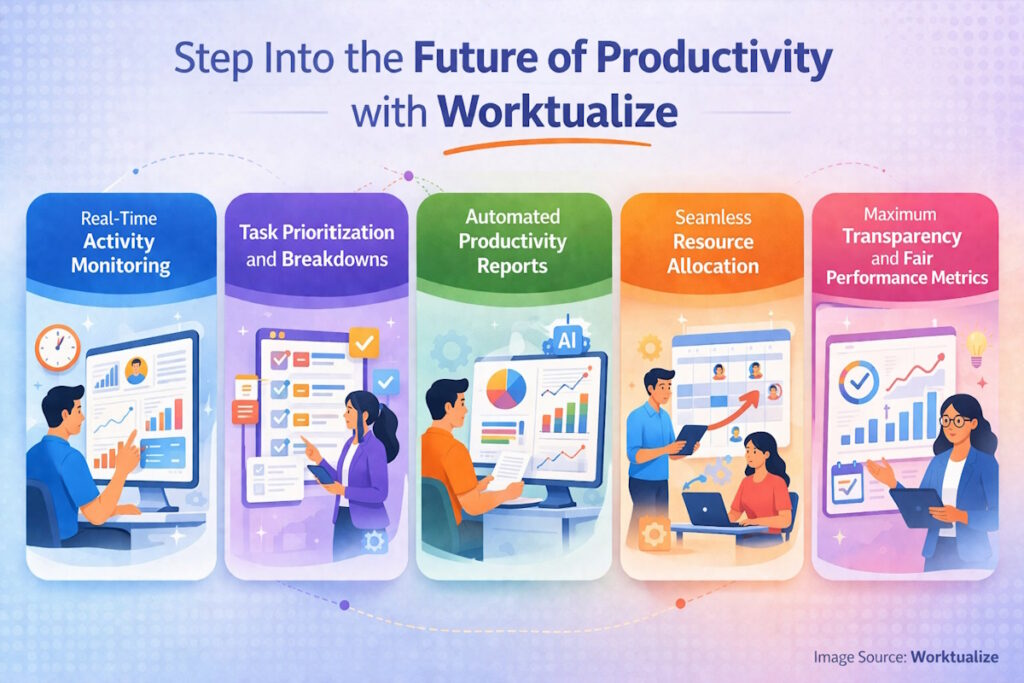
- Real-Time Activity Monitoring: Gain deep insights into mouse and keyboard activity levels to ensure your team stays focused on what matters most. This helps you identify when a team member is struggling with a task and needs support before they get frustrated.
- Task Prioritization and Breakdowns: Easily break large projects into manageable milestones, ensuring a 94.5% on-time delivery rate. Our interface makes it simple to see the hierarchy of tasks, so nothing falls through the cracks.
- Automated Productivity Reports: Say goodbye to manual reporting. Get hour-wise breakdowns of daily activities delivered straight to your dashboard. Use these reports to show clients exactly where their budget is going.
- Seamless Resource Allocation: Use our intuitive My Team feed to see who is working on what in real-time. Identify idle time and assign tasks based on real-time expertise and current bandwidth.
- Maximum Transparency and Fair Performance Metrics: Foster a culture of trust with clear attendance tracking and role-based access. We respect privacy while maintaining the high level of accountability needed for a high-performing remote or hybrid team.
Organizations using Worktualize have reported a 25% boost in overall productivity and a significant reduction in project delivery cycles. In an era where efficiency is the only sustainable competitive advantage, can you afford to stay in the dark?
Don’t let your team fall behind in the race for efficiency. Try Worktualize Today and see how we can help you reclaim your time, boost your team spirit, and deliver your projects 30% faster. Focus on what is needed, put the right workforce at the right time, and watch your bottom line grow.