

For any modern-day enterprise, efficiency is the currency of growth. Organizations spend billions annually on digital tools designed to streamline operations, yet many leadership teams struggle to answer a fundamental question: Is this actually paying off?
When it is time to justify a new budget or renew a subscription for a tool like Worktualize, simply saying the team feels faster isn’t enough. You need hard data. Calculating the productivity software ROI requires a blend of financial metrics, workforce analytics, and a deep dive into cost savings analysis.
This guide will walk you through the precise formulas and strategic frameworks needed to prove that productivity software is an investment, not an expense.
Wondering how much time your team is actually wasting each week?
The ROI Challenge: Moving Beyond Gut Feelings
Most managers recognize the intuitive value of a streamlined workflow. However, the C-suite speaks the language of numbers. To secure buy-in, you must bridge the gap between daily task completion and the bottom line.
A successful productivity software ROI calculation focuses on four primary pillars:
- Direct Cost Savings: Reduction in overhead and billable leakage.
- Efficiency Gains: Time reclaimed from manual or redundant tasks.
- Strategic Alignment: Using workforce analytics to ensure talent is focused on high-value projects.
- Employee Retention: Reducing burnout by eliminating the friction of micromanagement.
To achieve this, you need to follow the five-step method.
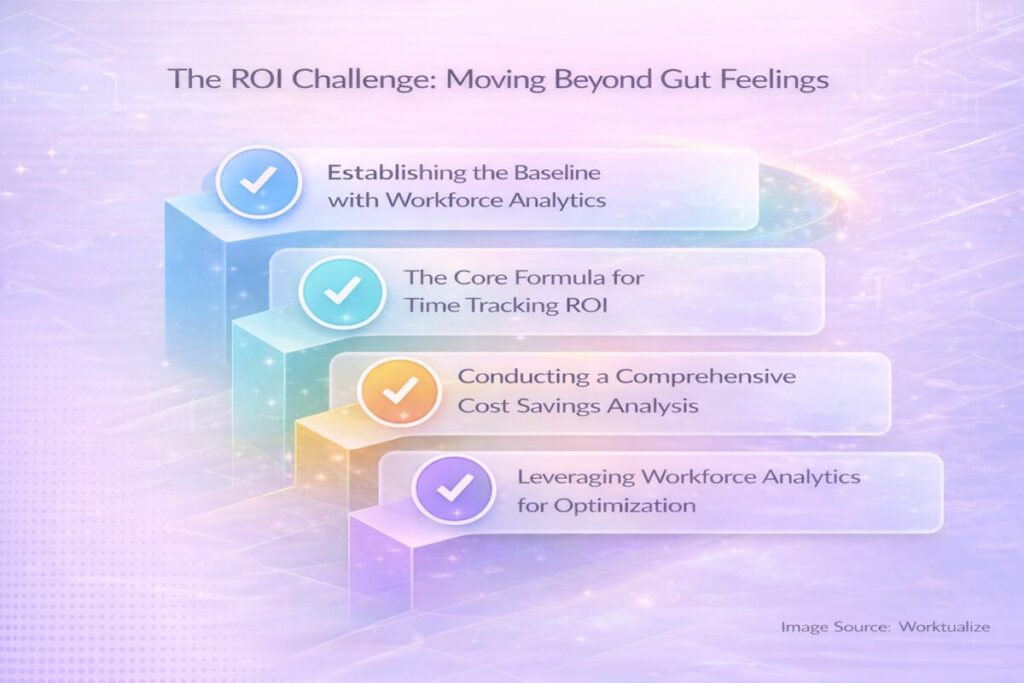
Step 1: Establishing the Baseline with Workforce Analytics
Before you can measure improvement, you must know your starting point. This is where workforce analytics becomes indispensable. Without a clear picture of how time is currently spent, any claim of improvement is mere guesswork.
Quantifying the Status Quo
Ask yourself:
- How many hours per week are spent on administrative overhead?
- What is the current ratio of billable to non-billable hours?
- How much time is lost to context switching or unnecessary meetings?
By using a tool like Worktualize, companies can gather this data silently. Unlike traditional trackers that feel like a leash, Worktualize provides a high-level view of activity without invading privacy. This allows for an honest cost savings analysis based on real-world behavior rather than idealized schedules.
Step 2: The Core Formula for Time Tracking ROI
The most direct way to prove value is through a time tracking ROI calculation. The logic is simple: if a tool saves every employee 30 minutes a day, what is that time worth to the company?
The Calculation
ROI = [(Time Saved × Hourly Rate × Number of Employees) – Cost of Software] ÷ Cost of Software × 100
Example Scenario
Imagine a firm with 50 employees, an average hourly cost of $50, and a software cost of $5,000 per year. If Worktualize saves just 2 hours per week per employee by automating reporting and reducing manual logs:
- Total Hours Saved per Year: $2 \times 50 \times 52 = 5,200$ hours.
- Gross Savings: $5,200 \times \$50 = \$260,000$.
- Net Profit: $\$260,000 – \$5,000 = \$255,000$.
In this case, the time tracking ROI is a staggering 5,100%. When presented this way, the software pays for itself in the first few weeks of implementation.
Step 3: Conducting a Comprehensive Cost Savings Analysis
While time saved is the most obvious metric, a true cost savings analysis digs deeper into hidden expenses. Productivity software often replaces multiple disparate systems, leading to a consolidation of the tech stack.
Reducing Billable Leakage
For agencies and service-based businesses, unrecorded time is lost revenue. If an architect spends 15 minutes on a client call but forgets to log it, that revenue vanishes. Worktualize helps capture these moments automatically. Closing the gap on billable leakage increases the ROI of productivity software because you are capturing revenue that was already earned but never invoiced.
Eliminating the Shadow Cost of Micromanagement
Micromanagement is a silent killer of ROI. When managers spend hours checking in on status updates, they aren’t leading; they are policing. Worktualize provides transparency through its dashboard, allowing managers to see progress without sending a single status update. This frees up leadership to focus on strategy, which carries a much higher internal rate of return.
Step 4: Leveraging Workforce Analytics for Optimization
Data is only as good as the decisions it inspires. Workforce analytics allow you to move from defensive accounting to offensive strategy.
Identifying Bottlenecks
Are certain departments consistently over-capacity? Is a specific type of project always running over budget? Analyzing trends over months, leadership can redistribute workloads or adjust pricing models. This strategic shift is a major component of productivity software ROI that goes beyond simple clock-watching.
Improving Predictability
When you have a historical record of how long tasks actually take, your bidding and project estimation become much more accurate. This leads to higher profit margins and fewer project overruns, further strengthening your cost savings analysis.
What would a 5,000% ROI look like inside your organization?
Why Worktualize is the ROI Engine Your Team Needs
Many tools promise productivity but deliver resentment. Suppose a software feels like Big Brother, employees will find ways to circumvent it, rendering your data useless. Worktualize was built on a different philosophy: tracking without the sting of micromanagement.
Privacy-First Productivity
Worktualize focuses on outcomes and activity levels rather than invasive screenshots or keystroke logging. This maintains trust within the team. High morale is directly linked to higher output, meaning the productivity software ROI stays high because the team actually wants to use the tool.
Seamless Integration
The best software is the one that disappears into the workflow. Worktualize offers features like:
- Automatic Time Capture: No more manual timers that people forget to start.
- Intuitive Dashboards: Instant workforce analytics for quick decision-making.
- Custom Reporting: Ready-made data for your next cost savings analysis.
Factoring in Intangible ROI
Not every benefit fits neatly into a spreadsheet, but they are vital for long-term health. When calculating your total productivity software ROI, consider these qualitative factors:
- Reduced Burnout: Identifying over-utilization early via workforce analytics, and you can intervene before a top performer quits. The cost of replacing an employee is often 1.5x to 2x their annual salary. Preventing even one resignation can save the company $100,000 or more.
- Improved Culture: A culture of autonomy is supported by non-intrusive tools like Worktualize, which attracts better talent.
- Data-Driven Feedback: Performance reviews become objective. Instead of relying on a manager’s mood, you have a year of time tracking ROI data to show exactly how much value an employee contributed.
Common Pitfalls in ROI Calculation
To maintain credibility with your finance department, avoid these common mistakes during your cost savings analysis:
- Overestimating Time Savings: Be conservative. It is better to promise a 10% gain and hit 15% than the other way around.
- Ignoring Implementation Costs: Factor in the time it takes to train the team and set up the software.
- Using Static Data: Workforce analytics are dynamic. Refresh your ROI report quarterly to show the compounding benefits of the software over time.
The Roadmap to Approval
If you are looking to bring Worktualize into your organization, follow this three-step plan to prove its value:
1. The Pilot Phase
Run a 30-day trial with a single department. Use the internal workforce analytics to establish a before-and-after snapshot.
2. The Efficiency Report
Highlight a specific pain point—such as the time spent on manual weekly reports—and show how the software eliminated it. Use this to calculate a preliminary time tracking ROI.
3. The Scaling Proposal
Present the findings to leadership. Use a table to compare the cost of the status quo versus the projected cost savings analysis of a company-wide rollout.
| Metric | Without Worktualize | With Worktualize |
| Time spent on reporting | 4 hours/week | 10 minutes/week |
| Billable leakage | Estimated 15% | Under 2% |
| Management check-ins | Daily/Intrusive | As-needed/Data-backed |
| Productivity Software ROI | 0% | Projected 450%+ |
Deep Dive: The Hidden Costs of Poor Time Tracking
Many organizations believe they are saving money by avoiding software costs, but the lack of time tracking and ROI visibility creates massive financial drains. Manual spreadsheets are prone to error, take hours to compile, and provide zero real-time insight.
The Opportunity Cost of Administrative Friction
When your best engineers or creative directors spend Friday afternoon filling out timesheets, you aren’t just paying for their time; you are losing the creative output they could have produced during those hours. Worktualize solves this by capturing activity in the background. This shift allows your team to stay in the flow state, which is where true value is created.
Strategic Resource Allocation via Workforce Analytics
The ultimate goal of any leader is to have the right people on the right tasks at the right time. This is where workforce analytics transcend simple tracking and become a tool for business intelligence.
When you analyze the data from Worktualize, you can see:
- Skill Gaps: If a specific task takes twice as long for one team as another, it might indicate a need for training rather than a lack of effort.
- Project Profitability: Not all clients are equal. Use your cost savings analysis to identify which projects are actually draining resources despite high top-line revenue.
Worktualize for Turning Data into Action
Proving the value of a tool isn’t about flashy features; it’s about demonstrated impact. When you focus on productivity software ROI, you transform the conversation from what does this cost? How much are we losing by not having it?
Through the smart application of workforce analytics and a rigorous cost savings analysis, you can show that Worktualize is the missing piece in your operational puzzle. It provides the visibility needed to scale, the data needed to save, and the respect for privacy needed to keep your team happy.
The numbers don’t lie. When you reclaim time, you reclaim your bottom line. Stop wondering if your team is efficient and start knowing the real productivity tracking without any hint of micromanagement with Worktualize.